President Lee is starting to sound like ex-Pres Yoon
Why it matters: As President Lee’s approval sinks toward Yoon Suk-yeol’s, his party is discovering it cannot afford his legal self-defense, and both are reaching for illiberal tools: he for a social-media mirror that shows him a reactionary plot, Minjoo for a rulebook that benches its critics.
The Prosecutions Minjoo Can’t Afford to Drop
When Yong Hye-in, the gender minister nominee, called a press conference on Thursday, I expected her to call it a day. She had been under fire on various fronts, and even some in her ally, the Minjoo Party, had begun to turn their backs on her.
To my surprise, Ms Yong doubled down. She denied allegations against her Basic Income Party and said she had taken the nomination to meet “the appointer’s expectations.”
Three days later, however, she dropped out. This time she said Minjoo had asked her to “make a decision” given the thin public consensus on holding both posts, and that serving was “practically difficult” when even the ruling party was voicing concern. She thanked Mr Lee and blamed the People Power Party and the press.
It looks to me like Minjoo and the Lee administration threw Ms Yong under the bus because they needed a scapegoat to pass Kim Seung-won, the justice minister nominee. Mr Kim is a Minjoo lawmaker who co-chaired the group of party colleagues pushing for withdrawal of the indictments against Mr Lee. It’s hard to believe, however, that Mr Kim’s road to the ministry will be smooth, as he is going to take all the limelight in the confirmation hearings on the new nominees starting this week.
It’s not about Mr Kim himself, but about what he’s supposed to do once he becomes the minister: withdrawing the indictments against President Lee.
The problem is that Minjoo and Mr Lee are not aligned on this front. In Korea, a president’s authority is like an hourglass: it only runs down. In other words, Mr Lee’s window for disarming the legal landmines awaiting his retirement is closing.
It’s a bit different for Minjoo. If it lets Mr Lee and co drop the charges, many of its lawmakers won’t survive the next election in the ensuing public uproar. The fact that Mr Lee is an outsider to Minjoo’s majority Gen-86 faction, allied with former President Moon Jae-in, further aggravates the alignment issue.
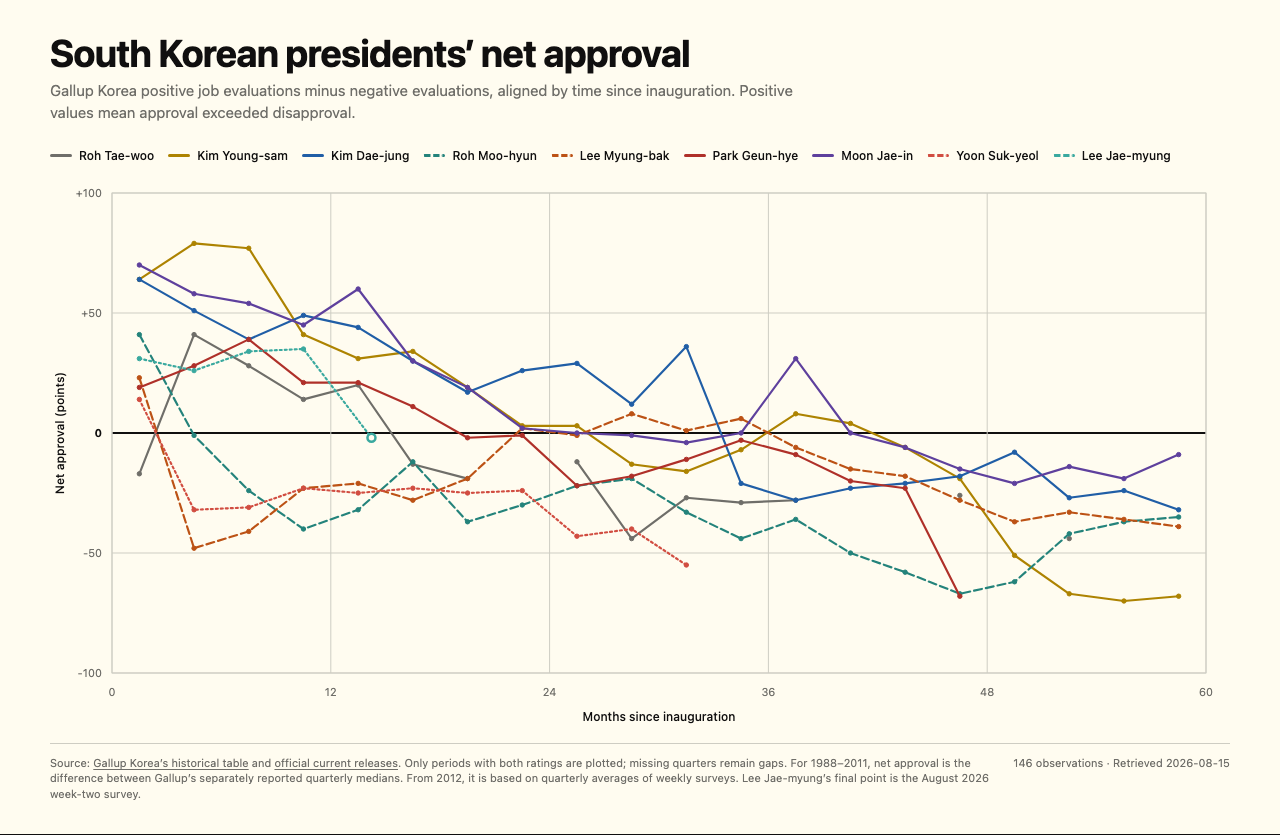
It all looked fine when Mr Lee was basking in high approval ratings. With his ratings nosediving — as low as former President Yoon Suk-yeol’s at the same point in his term, in some polls — now we see cracks everywhere.
It began with Minjoo-aligned political commentators, and now even some prominent incumbent Minjoo politicians criticize Mr Lee in public. Gyeonggi Governor Choo Mi-ae’s public criticism is noteworthy, not because of the content — she was still selling the old anti-prosecutor narrative to hardcore Minjoo supporters — but for the fact that she turned her back at all. Political instinct was the only thing that made her career last.
The harder the Lee administration tries to drop the charges, the stronger the pushback from the ruling party will be. It wouldn’t only dim Minjoo’s prospects in the next election — those who engineer the withdrawal could face abuse-of-power charges of their own. That, I suspect, is why this fiasco surrounding a new justice minister happened in the first place: Jeong Seong-ho, the former justice minister, resigned because he knew where it was heading.
The Magic Mirror
To put it bluntly, as Mr Lee’s ratings come closer to Mr Yoon’s, so does his worldview. For Mr Yoon, it was election fraud and Minjoo’s legislative despotism. For Mr Lee, it’s a reactionary establishment out to derail his reforms.
The most powerful man in the country can also be the loneliest, and social media now lets anyone with an account watch that loneliness in real time, as long as the leader is blabby enough. Donald Trump is the obvious case. Mr Lee is another.
I’ve already pointed out his relapse into his vitriolic self on social media. But what we’ve been seeing recently is something quite different. His perception of political reality appears to be getting skewed.
The first tweet that raised eyebrows was his warning to “real estate speculators” last month. Some criticized his words for sounding almost gleeful — he cites rising mortgage defaults and foreclosures right before promising speculators a “double check,” the chess move that attacks two pieces at once, by pumping up the housing supply.
Well, Mr Lee relishing his enemies’ pain is nothing new, but his words don’t reflect the truth of the housing market these days. Experts were quick to point out that the rising defaults and foreclosures are due to the hollowing out of the regions (as opposed to greater Seoul) and that there’s no sign of easing in Seoul housing prices. Mr Lee’s guys are not giving him the full picture.
Social media plays a role in both cases: like a magic mirror, it can show you anything you’d like to see. Mr Yoon allegedly watched a lot of conspiracist videos on YouTube, and Mr Lee loves to quote other users’ flattering tweets about him before laying out a self-serving harangue.
The most recent one is his Saturday tweet. Quoting a sycophantic tweet wishing him success, he portrays himself as a wounded king reformer.
He ends the tirade with a chilling line: “The greatest obstacle to reform is obstructing reform in the name of reform.” It is not easy to decipher exactly what he means; many interpreted it as a warning to the likes of Ms Choo. But the tone is scarily close to that of Mr Yoon before he declared martial law.
Minjoo’s democracy, too, is increasingly taking on an illiberal hue. Kim Min-seok, the party chief, seeks to amend the National Assembly Act so that the chamber can suspend a lawmaker’s qualifications. The Constitution requires two-thirds of the Assembly to expel a member; a suspension written into ordinary law would need only the majority Minjoo already holds. The first names on the list were Han Dong-hoon, the independent former PPP leader who used internal prosecution documents to accuse the justice minister nominee of lobbying regulators, and the PPP’s Lee Jin-sook, the former broadcasting regulator. Kim Min-seok has since said he would leave Mr Han out “for the time being,” because, in Minjoo’s telling, Mr Han will face the courts as a suspect in the leak anyway. Lee Jin-sook stays on the list.
All these developments point in the same direction. Mr Yoon’s slide ended with a president who trusted YouTube over his party and reached for the army. Mr Lee has no army to reach for, and Minjoo would not follow him if he did. But the pattern rhymes: a president who trusts his own clock over his party’s, a party that trusts the rulebook over the voters, and a public that has watched this film before and knows how it ends.
The first test comes this week. Kim Seung-won’s confirmation hearing will show whether Minjoo lawmakers defend a nominee whose job is to drop their leader’s charges or quietly follow Ms Choo out the door. Watch the hearing room, but watch Mr Lee’s feed harder. The mirror has not finished talking.